As a childcare volunteer in Peru, you will provide additional support to childcare projects within the city of Cusco. Not only this, Peru's volunteer programs provide a great foundation to improve your Spanish. Provide a much needed helping hand for some of the most disadvantaged and underprivileged children in the local communities as you volunteer with children in Peru.
BACKGROUND TO THE CHILDCARE PROGRAM
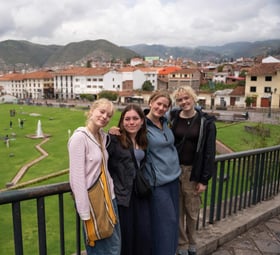
The majestic city of the Incas, whilst tourist-based and thriving, is a city of the poor. People will travel from hungry villages hoping to sell their crafts and clothes just to make enough to eat. Each year in the city of Cusco, millions of tourists visit to explore the Incan culture and venture to Machu Picchu. Although high tourism and a thriving economy exist, more than half of the population still lives in poverty.
Due to the inability to make enough money to support their families, tourists will encounter child beggars at all hours. Among the poverty, the ageless majesty of the Incan empire radiates from the streets of this historic city.
As you walk the cobblestone streets taking in what Peru has to offer, you will witness many street children. They may be posing with Llamas or adolescents pushing carts of cheese to the nearby market. You will be able to notice their features and recognise they are all direct descendants of the Andes rulers.
In this indigenous culture, many children are subject to troubling home environments due to low income, addiction, violence and neglect. We work with local organisations to help children that have great need. The projects range from kindergartens and daycare centres to supporting children with a range of physical and mental disabilities.
The kindergarten projects and those for working children are essential in restoring families. Furthermore, they are essential in providing necessary assistance to ensure children have additional support mechanisms. By completing volunteer work in Peru on these projects you are contributing so that children can be fed and educated. Ultimately, this will help children become positive citizens in their local communities.
Lower-class families do receive some minor assistance from the government. However, in many situations, the families still require their children to leave school and take to the streets for work. Due to this reality, local groups including police, language schools and local NGOs team up to provide support. This support includes provisions of free food, shelter, entertainment and clothing.
There has also been an increase in assistance for those with disabilities. In many parts of Peru, the conditions are far too rural to provide appropriate care for those with physical and mental disabilities. In Cusco, the local government has provided the necessary education and infrastructure to provide care for children of 4-17 years old.
Education centres and specialist schools have been developed to care for disabled children so parents can work and earn money. Such establishments focus on children with greater needs than the average child. Examples include supporting those with severe autism, bipolar, down syndrome, ADHD, Muscular Dystrophy and missing limbs.
Volunteer opportunities in Peru provided by us will provide you with a platform to make a positive impact. When working at our childcare volunteer abroad projects in Peru, it is important to maintain energy, enthusiasm and creativity. Since many of these children will be seeking the care and attention that you as a childcare volunteer in Peru can bring. To volunteer with children in Peru, you will need to donate your time and skills effectively. This is to ensure you can maximise your impact on the local people.
CHILDCARE VOLUNTEER PLACEMENT EXAMPLES
The Pronoei Project - Designed as a non-formal kindergarten for low-income families, the Pronoei Project offers free early childhood education and care for families in need. Funded by the Ministry of Education of Peru, each Pronoei centre is led by a local community member, who maintain the centre in a teacher role. The program operates for 4 hours daily, with minimal costs for attending families.
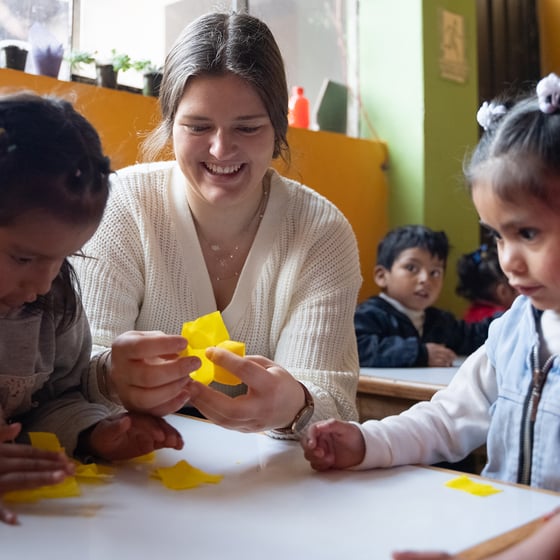
The program serves children aged 3-5 in a single combined class, with hours running from 9am-12:30pm. As you volunteer with children in Peru, you will assist local staff with various tasks, including lesson planning, playing with the children, and organising workshops. These workshops focus on culturally relevant childcare practices that are valuable across local communities.
In addition to classroom activities, volunteers also support efforts around nutrition and hygiene, such as preparing meals and teaching children proper handwashing and tooth-brushing techniques. The project encourages volunteers to develop their own routines and engage in areas that best match their skills and interests.
The Pronoei Project supports several underserved kindergartens in the Cusco region, each hosting one volunteer at a time. Each centre typically serves around 30 children with a single community teacher, making volunteer support essential. Although the facilities are small, crowded, and under-resourced, the additional help volunteers provide is highly valued by both the children and the staff.
The Escuela Especial San Juan de Dios - Founded as a school centre for disadvantaged children, The Escuela Especial San Juan de Dios is home to children with disabilities of both mental and physical capacities.
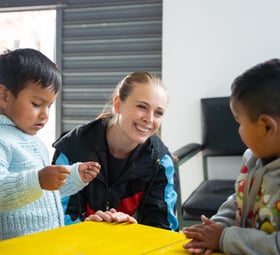
In the city of Cusco, there are only 4 schools for disabled children which makes this program so special! You will work with children with the mental capacity of those up to 6th grade. Although they reach the 6th grade level, the children can be anywhere from 3-20 years of age. The work schedule is only in the morning from 8am-1pm. At times, there are occupational training courses for older children from 1pm-6pm.
In every classroom, there is one teacher with a maximum of 10 children. They have only one teacher-assistant that rotates through all courses. Because of this, volunteers are very welcome as most children require individual attention.
In a classroom of young children, you may encounter that the group sizes average around 6 children. However, the workload is much higher than those in bigger groups and at a higher age level. The teachers try very hard to educate the children in basic skills to then pass on to future levels of education. The children will also have skills to help at home in their spare time.
In the higher levels, the students will learn to do activities like sewing, cooking and art. These skills can be used at home, occupational jobs and/or doing tourism-based sales like artwork or local craft. This allows you to interact on a more detailed and personal level in a skill-based environment. The younger levels are enjoyable and more informal as you sing songs, learn letters and do some painting.
Specific tasks that volunteers will participate in are classroom assistance, meal team and food preparation. More creative aspects include crafts and stimulation activities for those with confining disabilities. If volunteers wish they can rotate between groups during their period of volunteering.
At Escuela Especial San Juan de Dios there is one physiotherapist that gives therapy during school schedule. A volunteer can be assisting during their work to gain experience and help when it is needed.
OTHER THINGS TO CONSIDER WORKING WITH CHILDREN IN PERU
Return Airport Transfer - Your return airport transfer is not included in your Program Fee. The most common method is to use a ridesharing app or private taxi service. Participants can often be travelling across their final few days and therefore are not necessarily heading back to the airport directly from our accommodation. The costs depend on your method of transport and your final destination. This can often be split across multiple participants if you are travelling with someone else on the program.
Resources - On the childcare project in Peru, resources can be very limited. Volunteers are recommended to bring materials to the project each day to maximise their productivity and day to day involvement. It is therefore important for volunteers to prepare well in advance to get the most out of their childcare volunteering experience in Peru.
Spanish Requirements - For the childcare program in Peru, we recommend that you speak a reasonable level of Spanish prior to your trip. There are no specific language requirements in order to join the program and you can join as an absolute beginner. However, we find that the ability to speak a good level of the Spanish language and a passion to learn more will greatly enhance your overall experience. This is because English is generally not widely spoken and therefore our programs should be viewed as a broader language immersion experience. If you do not speak a reasonable level of Spanish then you will find it difficult to communicate. As a result, this could lead to a more frustrating experience.
We also offer Online Spanish Lessons that you can take before your trip. The lessons provide you with the opportunity to receive one-on-one classes from a trained Spanish teacher. Classes are held via Zoom and can be worked around your schedule back in your home country.
We also offer a learn Spanish in Peru program which you can take part in prior to your volunteer placement. This provides you with 20 hours-per-week of group Spanish lessons. Both of these options can be added during our online application process. They are highly recommended if you want to make the most of your volunteer placement.
Once you are in-country then you are also able to organise additional Spanish lessons directly with our local team. Volunteer feedback suggests that it can often be tiring to complete Spanish lessons at the same time as your volunteer programs in Peru. Consequently, we generally recommend extending your Language Immersion Program.
Project Commitment - For our childcare and teaching community projects we generally recommend where possible a minimum 4 week commitment from volunteers. This is so both the volunteer and project can maximise their experience.
We still have project availability for 2 and 3 week placement options where the placement benefits from volunteer support. However, such projects are usually limited to kindergartens for childcare and the afterschool project for English teaching. As a result, shorter-term volunteers will complete their volunteer work in such project settings accordingly.
Project Donation - With each volunteer, there is a donation made directly to the volunteer project you join us in Peru. This donation fee is included in the Program Fee you pay before you depart for your trip.
With that donation, the project is provided with increased financial support to improve resources, infrastructure and project environment. Such beneficiaries being the patients at the medical clinics, students at the schools, children at the kindergartens or the dogs at the dog shelter project.
Placement Settings - We do not provide volunteer opportunities in orphanages in any of our locations. Research and studies have shown that visiting and volunteering in orphanages has the potential to generate an industry that separates children from their families. In turn, putting children at increased risk of neglect and abuse. Therefore, we do not support these institutions with our volunteer network.
Instead, we focus on offering alternative childcare volunteer opportunities whereby children come to and from the placement setting each day. In other words, our local teams collaborate with childcare projects which do not offer any form of residential care. These are safe, responsible, and vetted projects, where participants continue to provide valued assistance supporting local staff.
Weekends - Your project work in Peru runs from Monday-Friday and weekends are free. You are welcome to relax and hang out at the volunteer accommodation but most participants will use this time to travel and explore the country. As a result, you can check out our Peru Weekend Travel Guide for top tips on how to spend your weekend. We also run two separate weekend trips which you can sign-up to before you depart for Peru. We offer the Lake Titicaca & Islands Trip along with the Machu Picchu Trip with opportunities running every month.