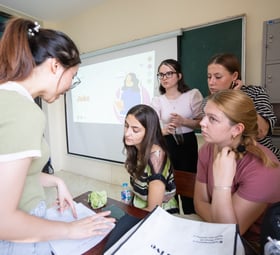
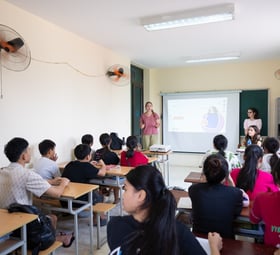
As a volunteer teaching English in Vietnam, you will work to encourage students to develop skills that will help them to achieve their future goals. Conversing with fluent, native English speakers greatly improves their language skills, essential for future employment. This project provides the perfect opportunity for international volunteers to teach English in Vietnam, putting their leadership skills into practice across schools and communities in Hanoi.
BACKGROUND TO THE TEACHING PROGRAM
Education is becoming an increasingly important issue in Vietnam. Traditionally, agriculture has provided jobs for the masses, but this sector’s growth has plummeted. Nowadays, international commercial trade governs the Vietnamese economy, especially in major cities such as Hanoi and Ho Chi Minh City. This economic shift has created a greater demand for skilled labour and a workforce that is multilingual. In such circumstances, English is frequently the main language required.
In recent years, access to primary and secondary education has risen significantly, and schools have received increased levels of funding. Furthermore, there is a greater focus on physical, psychological, social and emotional growth, alongside general educational achievement. English language training was introduced into the national curriculum in 2010. This follows continued recognition from the government for the importance of the ability to speak English to young people.
We support a range of educational establishments and classes, from government high schools to universities and education classes for the local community. The aim of our teachers in Vietnam is to create an environment that encourages students to practice their English and improve their confidence. We encourage volunteers in Vietnam to keep the lessons fun. Being creative to make the lessons interesting will encourage the students to engage and improve their confidence.
TEACHING VOLUNTEER PLACEMENT EXAMPLES
Community & University Classes - Alongside our work with schools in Hanoi, our volunteers in Vietnam contribute to a number of community classes. These take place within the local community and nearby Universities. There are typically four different levels of classes per Community/University setting. Each class will attend two sessions per week. Every day, volunteers will engage in two classes: one morning, and one afternoon. The first hour of the lesson will typically focus on learning and understanding English vocabulary and phrases. The second hour tends to concentrate on putting this into practice.
The community classes are attended by high school and university students wishing to improve their English. Unfortunately, these individuals cannot afford private tuition. Most of the students come from rural areas and move to the city to attend university. The aim of the classes is to create a fun and interactive environment for the class participants to practice their English. On average 5-20 people attend each class.
High Schools - The main school we support is Nguyen Tat Thanh (NTT) project. NTT is a secondary school (11-18 years of age), home to over 2,500 students. English language skills are of growing importance at the school. However, the local teachers tend to focus on teaching listening, reading and writing skills, rather than focussing on communication skills. This is often because this is an area they are limited in themselves.
NTT is fairly well-resourced, but the school cannot afford to hire enough native speaking English staff. Furthermore, with large class sizes, it is difficult for teachers to give students the individual attention they need. Therefore, English speaking volunteers make an invaluable contribution to the school's ambition to improve the English of their students. There may also be the chance to help with sports classes: badminton, basketball, football and volleyball are the main sports taught. If willing, as a volunteer teaching English in Vietnam, you can also spend time helping improve the English of the teaching staff. This helps bring about long term development at the school.
Circus and Vaudeville College - The Vietnam Circus and Variety Arts College was established in 1961. The college is a centre for creating, staging, and experimenting with new, modern circus acts while also preserving and restoring traditional circus acts. Currently, the program is the only training institution for professional circus performers in the whole of South East Asia. Most students who attend the project are aged from 12-17 years of age.
With support from the Ministry of Culture, Sports, and Tourism, the college has grown in various fields. To date, the college has trained over 40 courses of circus performers and individuals working in the arts. Through many international missions, the college has conducted numerous short-term training sessions and long-term training courses, to enhance the skills, techniques and teaching expertise of neighbouring countries. The college has contributed to the founding of many circus troupes at home and abroad.
The students at the school are required to combine their training and performance commitments with academic endeavour. Therefore, they combine their practice time in the gymnasium with studying in the classroom. With students from the college often travelling and competing in international events, improving their English language skills is of great benefit. As a volunteer teaching English in Vietnam, you will assist students in enhancing their proficiency in English. Most importantly, developing interactive tasks focussing on improving their communication skills.
By fostering a positive and interactive learning environment, international volunteers will help inspire students to become more confident with the English language. As a volunteer in Vietnam, you will make lesson plans and prepare materials before each class. Such lessons will cover a variety of English topics. Volunteers are encouraged to lead class-based activities which focus on building the speaking and listening skills of the students. The students are typically excited to learn from international participants so be sure to bring lots of energy to this project. A local team member will also support volunteers to manage the students during the class.
OTHER THINGS TO CONSIDER TEACHING IN VIETNAM
Return Airport Transfer - Your return airport transfer is not included in your Program Fee. Our local team can help arrange onward transfers to the airport or an alternative destination from the volunteer accommodation. Making specific arrangements once in Vietnam provides more flexibility as plans can often change and participants may be on similar flight plans. Alternatively, a more common and cheaper method is to use a ridesharing app. Participants can often be travelling across their final few days and therefore are not necessarily heading back to the airport directly from our accommodation. The costs depend on your method of transport and your final destination. This can often be split across multiple participants if you are travelling with someone else on the program.
Experience - For the English Teaching program, teaching experience is not essential as the mere presence of a native English speaker is invaluable. As long as you are creative, determined and resourceful you can have a constructive impact on the development of the children’s education.
TEFL Course - We encourage volunteers to prepare as much as possible for their teaching program overseas. You can make the most out of your time by completing our convenient, inexpensive and international accredited 60 hour Online TEFL Course. The cost of this course is only 150 USD.
Resources - On the teach English in Vietnam project, resources can be very limited. Volunteers are recommended to bring materials to the project each day to maximise their productivity and day to day involvement. It is therefore important for volunteers to prepare well in advance to get the most out of their teaching English project experience.
Project Availability - When you participate in your volunteer work in Vietnam, your project location will be dictated based on the greatest need at the time. Where possible, the local team will place participants on their preferred project, when this has been noted within their application. However, this cannot be guaranteed in any case, and participants must be open to working in any location.
During June and July, most schools in Vietnam and universities will be on summer vacation. During this time, volunteers on Vietnam English teaching program will be placed within one of our community classes or a summer camp. Each summer camp lasts around 2 weeks within a relatively relaxed and casual setting. In these cases, there are usually three levels of students, with each level taught separately: Primary, Middle School and High School. Every group receives ten lessons, one each day over a period of two weeks (Monday to Friday).
Weekends - Your project work in Vietnam runs from Monday-Thursday and weekends are free (Friday-Sunday). You are welcome to relax and hang out at the volunteer accommodation, but most participants will use this time to travel and explore the country. As a result, you can check out our Vietnam Weekend Travel Guide for top tips on how to spend your weekend. For those who wish to stay in Hanoi on Friday, you are encouraged to continue your participation in the project as usual.