Login

Selezionare le date di viaggio per vedere i prezzi

Brillante 4.74rating (10)

Coral Reef Restoration Associate

location
4 - 24 settimane  ·  Età 18 - 50+
Verificato

Punti Salienti

  • Dive daily and participate in coral restoration efforts in the Mesoamerican Reef.
  • Earn your PADI Open Water certification and Coral Reef Conservation course.
  • Help grow and transplant coral fragments to revive damaged reefs.

Punti Salienti

  • Dive daily and participate in coral restoration efforts in the Mesoamerican Reef.
  • Earn your PADI Open Water certification and Coral Reef Conservation course.
  • Help grow and transplant coral fragments to revive damaged reefs.
  • Engage in community outreach by organizing beach clean-ups and events.
  • Experience the Caribbean beauty of Cozumel while contributing to a critical global conservation effort.

  • Non devi ancora pagare nulla

    Particolarmente adatto per

    Età 18+
    Singoli
    Coppie
    50+

    Sul programma

    Join a passionate team in Cozumel to protect and restore coral reefs through hands-on conservation efforts and daily diving adventures!

    The project on the paradisiacal Caribbean island of Cozumel is committed to the protection and restoration of corals, with the aim of restoring coral reefs and promoting research programs. The program was launched in 2013 by motivated biologists to counteract the death of corals. When the ...

    Sul programma

    The project on the paradisiacal Caribbean island of Cozumel is committed to the protection and restoration of corals, with the aim of restoring coral reefs and promoting research programs. The program was launched in 2013 by motivated biologists to counteract the death of corals. When the founder first dived in Cozumel, he was horrified by the condition of the corals and has since fought passionately to preserve them every day. And with great success.

    Cozumel is surrounded by a reef system over 1,000 kilometers long, the Mesoamerican Reef. It stretches in the Caribbean off the coasts of Mexico, Belize, Honduras and Guatemala and is the second largest coral reef in the world after the Great Barrier Reef. But the coastal areas are particularly affected by the effects of climate change. Not only does the rise in sea level pose a particular challenge for flat regions, but rising temperatures in particular threaten the aquatic habitat. The increased water temperature leads to increasing acidification and poses a threat to the up to 4,000 different species in the Mesoamerican reef. In addition, the increasingly frequent storms, which cause great destruction underwater and on the coast with strong winds and tidal waves, are a major problem for the already weakened coral reefs.

    The underwater world is a complex community of life that is dependent on one another. For example, many fish use the caves and crevices in the reef as hiding places from predatory fish and as nurseries for their offspring. Coral polyps and algae live in a unique symbiosis that gives the tropical reefs their colorful splendor. In addition, small coral polyps are an important source of food for many creatures and are therefore the basis for one of the most complex ecosystems on earth. When the ocean warms, this system breaks down and the creatures die.

    This coral death was documented on a large scale between 2014 and 2017. More than 70 percent of the world's reefs were affected. Global warming is also causing water temperatures to rise, which stresses the algae in the bodies of the coral-forming polyps (polyps are small, soft animals that attach themselves to hard surfaces). The algae give the coral its color and when they leave the polyp, the corals bleach and die. This global phenomenon is known as "coral bleaching." Almost 50 percent of the world's coral reefs have already died. If current developments are not stopped, the coral reefs and thus all other animals that live in this ecosystem will probably disappear almost completely in the next 30 years.

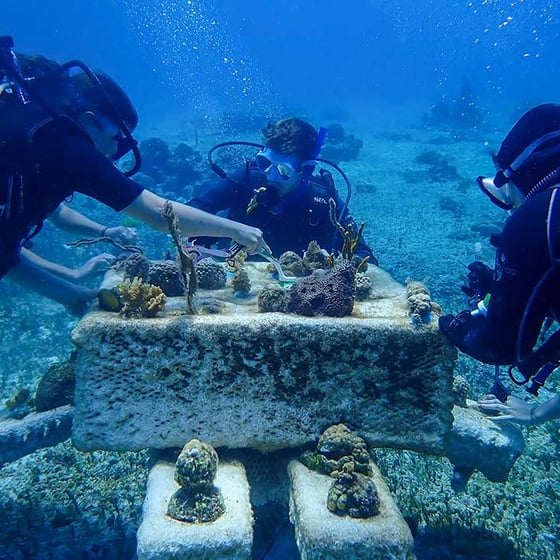
    The "Coral Reef Restoration" project has set itself the task of stopping the coral death and restoring the corals on the reef with the help of volunteers and donations. About 300 volunteers have already been trained in the art of coral restoration and have helped to create the marine park in Cozumel. There, corals are grown on concrete slabs with cup holders and reattached to the reef under constant care. In a controlled environment, the corals can slowly grow back without being affected by the effects of storms, overdevelopment or diver overload. Volunteers also learn how to maintain coral reefs, counteract contamination and disease, and how to reproduce and propagate them.

    The so-called Biorock reefs can be built in any size and shape and increase the settlement, growth, survival and resilience of corals and other marine life to severe environmental stresses such as high temperatures, pollution or storms. This is the only way to avoid coral extinction and all help is needed.

    Cozumel, approximately 46 km long and 14 km wide, is a vibrant tourist destination known for its Caribbean beaches, crystal-clear waters, and laid-back atmosphere. The island offers world-class diving spots such as the Palancar Reef and Santa Rosa Wall, stunning nature reserves like Laguna Chankanaab Park and Punta Sur Eco Beach Park, and fascinating cultural sites including the ancient Mayan ruins of San Gervasio. Visitors can also explore the colorful town of San Miguel with its waterfront promenade and the Museo de la Isla, experience local heritage at the Discover Mexico Park, and enjoy one of Mexico’s oldest and most colorful carnival celebrations, held for over 150 years. All of this makes Cozumel a diverse and unforgettable travel destination. The beauty of the reef nowadays attracts divers from all over the world to Cozumel, and there are now over 200 diving schools on the island. The many divers and especially their treatment of the ecosystem also contributes to the death of corals. For this reason, the project carries out educational work and is committed to making diving instructors and divers aware of this problem.

    In order to join the restoration efforts, all you need is a diving fitness certificate which states that no medical condition hinders you from diving -  and a bunch of excitement to support, protect and restore an amazing ecosystem! Otherwise, you will learn all the necessary skills at the project site. All diving equipment is provided by WanderWorld Travel, the only thing you require is your own wetsuit, and you're off into the sea!  


    Giornata tipica

    The main task of the project is coral restoration. But what exactly is that and how does it work? Coral reproduction can work in different ways. On the one hand, corals can reproduce by spawning, and on the other hand, through what is known as "fragmentation". During fragmentation, broken coral ...

    Giornata tipica

    The main task of the project is coral restoration. But what exactly is that and how does it work? Coral reproduction can work in different ways. On the one hand, corals can reproduce by spawning, and on the other hand, through what is known as "fragmentation". During fragmentation, broken coral branches can form a new colony elsewhere on a reef. The project has developed a method to use the natural fragmentation process to efficiently reproduce large numbers of corals. To do this, coral colonies are fragmented into smaller, finger-sized pieces and hung on so-called "coral trees". These coral trees are connected to the seabed and have space for up to 100 coral fragments. The trees float in the water column to prevent damage to the tree structure or the corals. The nurseries are located in places with as much sunlight as possible and nutrient-rich water columns so that the coral fragments can slowly grow into colonies. After about 6 to 9 months, the fragments are large enough to be "planted" on the reef. The corals are attached directly to the reef at selected reef restoration sites. Here, the corals can then spawn and continue to reproduce naturally. This method has proven itself and has shown that it is possible for reefs to eventually recover on their own with a little support. As a volunteer, you can experience this exciting process with your own eyes and help to implement the restoration tasks. So you have the opportunity to make a lasting contribution to the survival of the reefs and learn an incredible amount about "coral restoration".

    But there are also some tasks for you as a volunteer outside of the water. You will be responsible for organizing and running events, for example organizing beach clean-ups. You can also create flyers, manage social media channels and promote various projects. There are no limits to your creativity, but it is particularly important that you can work independently, as there is a lot to do. This means that your help is greatly appreciated and you have the opportunity to get actively involved.

    When you start your program in the "Coral Reef Restoration" project, you will first receive a week of diving training and complete the PADI Open Water Diver Course. All the equipment is provided by WanderWorld Travel. All you have to do is buy your own wetsuit and then you're off into the sea! In your diving course, you will learn both the theory for the diving license and the practical part in just a few days. After successfully completing the course, which ends with a small theory test, you will be ready to really work on the project.

    In your second week, you will also complete another two-day diving course on "Coral Reef Conservation" and then help with the coral restoration work in Cozumel. This means that you can dive every day, thus developing your skills and also contributing something to environmental protection. You will also learn a lot about the work of the project and can help with studies on the research and conservation of coral reefs. You will also learn a lot of theoretical knowledge about the reproduction of corals, which is helpful for working underwater.


    Attività del tempo libero

    Cozumel is a Mexican Caribbean island and is located right in front of the city of Playa del Carmen. The island is known for its white sandy beaches, azure blue sea and untouched nature. Many tourists come here to lie in the sun and relax on the endless beaches. But Cozumel offers so much more. In ...

    Attività del tempo libero

    Cozumel is a Mexican Caribbean island and is located right in front of the city of Playa del Carmen. The island is known for its white sandy beaches, azure blue sea and untouched nature. Many tourists come here to lie in the sun and relax on the endless beaches. But Cozumel offers so much more. In Playa del Carmen, one of the most beautiful activities is to take the ferry to Cozumel and spend a day on the island.

    The second largest coral reef in the world - the Mesoamerican reef - is located around the island. It is considered the best diving spot in all of Mexico. You can also book a submarine tour to the reef, for example, or simply snorkel there and marvel at the colorful fish and corals. There is also a shipwreck off Cozumel that sank in 2000 - the "Felipe Xicotenactl wreck". Sharks, turtles and rays are often found there.

    But there is also a lot to discover on land. Cozumel is home to the "Punta Sur Ecological Park", which covers an area of ​​around 2,500 hectares. The perfect place for nature lovers. There you will find exotic birds, crocodiles and turtles, but also beautiful plants and of course white sandy beaches. There is also a lighthouse that is part of the maritime museum, which you can visit and from whose vantage point you can even see the coast of Cuba on a good day. The park even has an old Mayan ruin - the "Tumba del Caracol". In the north of Cozumel there are other Mayan ruins, which are part of the archaeological site "San Gervasio".

    There is a lot to see and do on Cozumel. In the central part of the city there are countless bars and restaurants. Playa del Carmen is also only half an hour away by ferry and the boats run every hour.

    From Cancún International Airport you can reach the island by bus and ferry in about 2 hours.


    Requisiti

    Requisiti

    Età minima: 18 anni

    Per partecipare al programma è necessario avere almeno 18 anni alla data di inizio del programma. Potrebbero esserci delle esenzioni se si è in grado di fornire il permesso del proprio tutore legale o se si è accompagnati dai propri genitori.

    Competenze linguistiche

    È necessario parlare di Inglese (livello intermedio)

    Documenti necessari

    Registration form and Diving fitness certificate from a doctor

    Restrizioni sulla nazionalità

    Nessuna restrizione. Gli aiuti da tutto il mondo sono benvenuti.

    Altre competenze

    diving suitability, good health conditions, good swimming skills passionate about environmental protection not afraid of water or sea animals openness to new cultures

    Impegno di tempo

    Il vostro aiuto sarà richiesto lunedì, martedì, mercoledì, giovedì e venerdì

    Servizi inclusi

    Servizi inclusi

    Servizi in loco

    Accommodation is included in the fees and a communal kitchen is available. 

    Alloggio

    During your time in the project, you will live in a single or shared room in a hostel, right in the center of San Miguel de Cozumel. It is one of the most popular hostels in Cozumel and is visited by many young people from all over the world. You will quickly get to know other travelers there. The hostel has a pool and a great common area.

    The hostel has a kitchen that you are welcome to use. There are also numerous restaurants and bars in the town that serve regional dishes.

    The hostel is about 4 km from the project and the diving school. You can reach it by public transport, taxi or bicycle. The ferry to Playa del Carmen is a few minutes' walk away.

    Accesso a Internet

    Buon accesso al sito del progetto
    Non devi ancora pagare nulla

    Cosa NON è incluso?

    Cosa NON è incluso?

    Prelievo dall'aeroporto a Cancun International Airport

    Neanche il prelievo dall'aeroporto è incluso nel costo del programma.

    Cibo e Bevande

    Cibo, snack o bevande sono a pagamento.

    Biglietti aerei

    L'aeroporto più vicino è Cancun International Airport (CUN) a Cancun. Vi aiutiamo a trovare voli economici per Messico. TROVARE VOLI ECONOMICI

    Assicurazione di viaggio

    Andare all'estero è un'avventura ed è sempre meglio essere preparati. Malattia o infortunio improvviso, annullamento o furto: un'assicurazione di viaggio per Messico offre sicurezza ed è un vantaggio da avere. OTTENERE UN PREZZO

    Vaccini

    Se avete intenzione di fare volontariato a Messico dovete chiedere un parere medico prima di iniziare il vostro viaggio sociale. Controllare le vaccinazioni richieste per Messico. CHECKER PER I VACCINI

    Dettagli all'arrivo

    Volunteers can participate year-round and the program can start every Saturday. Please note that the minimum stay is one month.


    How to get there

    When you arrive at the airport in Cancún, you can take a public bus from the ADO terminal to the town Playa del Carmen. We can also help you organizing your transfer from the airport with a shuttle service. The drive is around 1 hour. From Playa del Carmen you can take a ferry to the island of Cozumel.


    Introduction day package

    WanderWorld Travel is organizing an introduction day in Playa del Carmen every first Saturday of the month for additional cost to welcome you in Mexico. On this day, you can meet our local guide in Playa del Carmen and other volunteers from the WanderWorld family. You can make your first contacts with other young travelers and get an introduction to the country, culture and cuisine. Please contact us in order to give you the exact date and price.

    In our introduction package is included:

    • Pick-up from the airport Cancún

    • 2 nights in a hostel in Playa del Carmen

    • Meet-up with our local guide in Playa del Carmen

    • Walking tour through the city with free lunch

    • Mexican sim card 

    Disponibilità
    gen feb mar apr mag giu lug ago set ott nov dic

    Tariffe del programma

    $347 tariffe settimanali 4 - 24 settimane Età 18 - 50+

    Modalità di pagamento

    Visa Master Card Maestro American Express PayPal

    NESSUNA COMMISSIONE PER LA CARTA DI CREDITO


    Durata

    4 - 24 settimane

    Deposito

    Prenotate il vostro posto con pochi clic e un piccolo deposito sicuro. È possibile pagare con carta di credito, PayPal o altri metodi convenienti.


    Pagamento Finale

    Il metodo di pagamento finale verrà concordato con l'organizzazione locale durante il processo di candidatura. Il pagamento finale è dovuto solo in prossimità dell'inizio del viaggio.

    Non devi ancora pagare nulla

    4,74
    ・
    10 reviews

    Posizione

    America > America centrale > Messico > Cozumel, Quintana Roo

    Incontra il tuo coordinatore di progetto

    Sophia
    10
    reviews
    4,74
    Brillante
    2018
    Fondata

    Verificato

      Tasso di risposta inferiore alla media
    Viaggia in sicurezza utilizzando Volunteer World per le tue comunicazioni e prenotazioni. In questo modo potrai beneficiare dell'Opzione Flex, della Garanzia di Rimborso e del Supporto alla Risoluzione.

    Potreste essere interessati anche a

    Contattare Sophia
      Tasso di risposta inferiore alla media

    La maggior parte dei volontari chiede


    Hai altre domande? Invia un messaggio a Sophia
    Per favore, non condividere le informazioni di contatto
    Selezionare le date di viaggio per vedere i prezzi

    Prenota con l'opzione Flex!

    Scegliete nuove date di partenza o passate a un altro programma di volontariato senza costi aggiuntivi entro 12 mesi.

    Supporto completo per ogni volontario!

    Questo ci aiuta a gestire la nostra piattaforma e a offrire servizi essenziali come l'assistenza completa, la garanzia di rimborso, l'opzione Flex senza costi di riprenotazione e la garanzia di prezzo. L'IVA è inclusa.

    Detagli del prezzo