Our Sanctuary
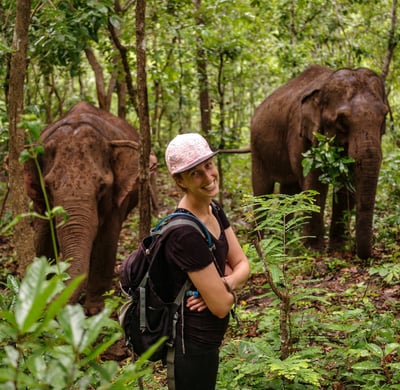
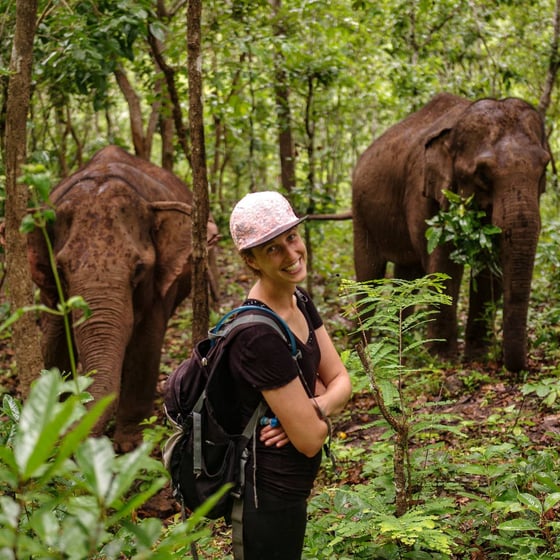
If you want to have a unique experience hiking in the forest to find the elephants and observing and recording their natural behaviours in their home environment, then Kindred Spirit Elephant Sanctuary is the right place for you. Come and join us for the experience of a lifetime. Volunteers must be physically fit to hike everyday up and down the mountains to get to the elephants. In our sanctuary, you can see exactly where your donations are going and how they are benefiting our sanctuary, our elephants and our community.
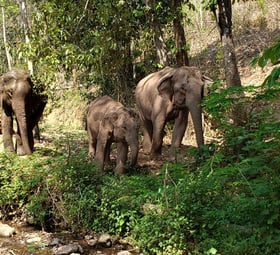
Our sanctuary is home to 7 elephants from the tourism industry and we have now brought them home to live out their lives in the forest, in semi-wild conditions. We need volunteers to help us keep these elephants happy and healthy in their natural habitat. With volunteer support and donations, we hope to return more elephants to the forest soon.
Our Village
Kindred Spirit Elephant Sanctuary is set amongst the rolling hills of Northern Thailand in a Karen etnic minority village. It is surrounded by a forest that is perfect for our elephants to roam and forage in.
The Karen people are originally from Myanmar but they have migrated to Thailand in search of a better life during the wars over many generations. Due to this they have their own language and culture, which volunteers will have the opportunity to learn and experience. They are keen weavers and are well known in Thailand for their elephant keeping. They make an income from their elephants and working in the fields, mainly growing rice and corn using rotational slash and burn. Volunteers will have the opportunity to learn more first-hand about their culture and even help out with the community when required.
This
internship is an exciting opportunity for any current or recently
graduated science university students who want more scientific work experience. It is also perfect for anyone with an interest in research or collecting data in the
field of animal behaviour. Applicants must have at least some previous data collection experience,
but a small amount of training will be provided on arrival.
******For your application******
Please answer the below questions as thoroughly as possible in your application (motivation letter):
1. Please describe any previous experience with in-field research.
2. Please describe any previous experience with data analysis and interpretation.
3. Our research internship at KSES usually involves interns focusing on one area of our research during their stay. This includes elephant foraging (watching one of our elephants for 1.5 hours each day, working with the mahouts to record what they are eating and ID-ing any new plants), elephant behaviour (watching any elephants in sight for 1.5 hours and recording what they are doing every 5 minutes), elephant association (watching any elephants in sight for 1.5 hours and recording their association to each other every 5 minutes) as well as a side project such as analysising our night time camera traps or another project that takes your interest. Personal research projects needed for your own degree or diploma are also possible. Does this sound like something that might interest you?
4. All interns are expected to take part in a fundraiser during their time. This usually involves working as a group with the other interns, setting up an online fundraiser page, running an event onsite such as a sponsored run, survival sleep out, sponsored challenges etc. and sharing this with family and friends. Do you have any previous experience of fundraising?
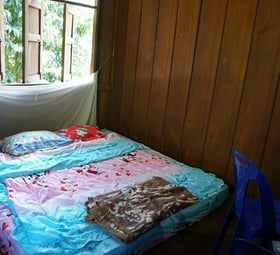
5. Living in a Karen village does mean working and living in a rural, basic and isolated environment, for example, we are a 5 hour drive from the nearest city (Chiang Mai), electricity, phone signal and running water can be unreliable at times, and sometimes you need to take cold bucket showers when there is little to no water running. Accommodation is basic (but comfortable), with your own private room in a homestay, usually with a mattress, on the ground, mosquito net and a shared bathroom. Have you ever lived rurally, basically or isolated before and is this something you think you will struggle with?
6. As we are working and living with another culture, we must ensure the people we bring out to stay come with an open mind and understanding that things will run differently than at home and we must respect all their traditions and culture, even if you do not always agree. This includes, wearing clothes that cover you from your shoulders to your knees and always following staff instructions who know and understand the culture. Do you have any previous experience of working or living together with another culture?
7. Why did you choose KSES and how did you find out about us?
8. What is the latest time frame you would hope to start the internship if accepted?