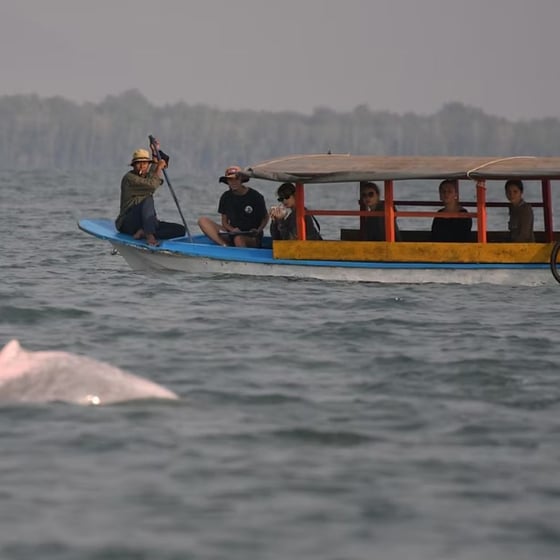
Khmer Ocean Life (KOL) works to conserve Cambodia’s marine and coastal ecosystems, with a focus on marine megafauna, through capacity building by conducting ongoing research and monitoring and empowering and collaborating with local fishing communities.
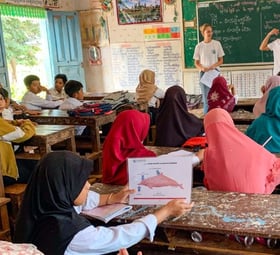
We work across all coastal provinces in Cambodia, undertaking population monitoring (land and boat surveys) of marine wildlife species, specifically Irrawaddy dolphins (Orcaella brevirostris), Indo-Pacific humpback dolphins (Sousa chinensis), Indo-Pacific finless porpoises (Neophocaena phocaenoides), dugongs (Dugong dugon), green sea turtles (Chelonia mydas), and hawksbill turtles (Eretmochelys imbricata). By gaining a deeper understanding of their distribution, abundance, and ecology, we aim to cooperate with decision makers and communities to inform sustainable conservation strategy and legislation throughout the Cambodian marine environment, which will ultimately protect these threatened species. Furthermore, through engaging local fishermen, KOL aims to educate coastal communities on the importance of conservation and facilitate responsible fishery and aquaculture practices, as well as strengthen relationships between Khmer people and the natural environment.
Conservation is a multifaceted field; as an intern, you will have the opportunity to explore multiple aspects of conservation that extend well beyond fieldwork. Interns have to opportunity to join on-going projects, strengthen partnerships with other local NGO's, and contribute to the capacity building of our organization and the greater community. Current projects include facilitating dolphin ecotours, contributing to bycatch mitigation efforts, applying for grants, maintaining the coastal-wide Cambodian Marine Mammal Bycatch and Stranding Network (season dependent), training of citizen scientists, and promoting conservation through outreach events and social media.
We have a passionate and dedicated team who continuously strive to work towards a healthier, more biodiverse ocean, and are always looking to further involve local and international volunteers and interns in our projects.
We have no requirements of interns, as we provide basic survey equipment on-site. If interns have binoculars, cameras, or access to specialized equipment (hydrophone, water testing kits, etc.), we encourage them to bring it. The most important thing an intern can bring is adaptability and motivation to learn and contribute.
If you have experience in social media or are interested in gaining experience in content creation, please explicitly include this in your application, as we are currently looking for a volunteer that can work as our media specialist.
Some things to know about Cambodia...
- Tap water is not potable - you can easily buy bottled water almost anywhere, but
we do recommend you bring a reusable drink bottle (water refills at most
accommodations and some restaurants too!)
- Modesty culture (i.e. clothing) is common and respectful, especially for women,
however many locals in towns are used to seeing Western tourists around
- You cannot flush toilet paper/tissue down the toilets - most bathrooms will
have a rubbish bin, and there is also a water hose to clean yourself (some places
do not have toilet paper available at all)
The town of Kampot
Kampot is a chilled but fun riverside town, with a mix of old French colonial and Khmerstyle architecture. Although there are some tourists, it is also a very local place to spend
time and has many delicious restaurants to choose from. Some activities you might wish
to do on your days off are:
- Visit Bokor Hill Station
- Kayak on the river
- Visit a spa for a massage
- Browse the local markets
- Karaoke - a Khmer favourite
- Visit a pepper plantation - Kampot is
famous for it's pepper
Planning
Transport to Kampot
- Tuk tuk from airport to Phnom Penh city centre ($10) + Bus from Phnom Penh city
centre to Kampot ($10) + tuk tuk to apartment from Kampot Bus Station ($2);
duration is about 4 hours
- Taxi - faster, but more expensive ($50-60)
- We advise downloading 'Pass App' or 'Grab App' for getting around in tuk tuks.
They are similar to Uber and come within a few minutes. This can also be used
from the airport to the city and will save you about $5
Recommended accommodation in Phnom Penh
$: Top Banana Hostel
$$: YK Arthouse or House Boutique Eco Hotel (personal favourite)
$$$: Okay Boutique
Recommended accommodation in Kampot
$: Monkey Republic Kampot (personal favourite)
$$: Bohemiaz Resort and Spa Kampot
$$$: Rikitikitavi
What should you bring?
Essentials
- Passport & copies of your passport in case
- 2 copies of your visa - required to enter Cambodia
- Scanned copies or photos of passport & visa on your phone
- Personal laptop/Tablet (Very important!)
- Cash (Cambodian Riel): many places don't accept card in Kampot, they take U.S. dollars, but must be in good condition - cannot be written on or
have small rips. There are places called 'Wing' where you can exchange dollars for Cambodian
Riel
Personal Items
- Binoculars (Very Useful!)
- Mosquito repellent
- Sun cream
- Adapters
- Portable charger
- First aid kit
- Toiletries - shampoo, toothbrush, etc.
- Personal medications
- Reusable drink bottle
- Raincoat
- Shorts
- Hat
- Sunglasses
- Comfortable shoes - sandals, flip-flops (shoes that can get wet)
- Cross-body bag / fanny pack
- Sealable bag - to keep items dry in the rain or on the boat
- Shirts covering shoulders & pants covering knees: There are some places such as temples and schools where your shoulders
and knees must be covered
Field Work
- USB stick / portable hard drive