Login

Wähle deine Reisedaten, um einen Preis zu sehen

Brilliant 4.72rating (10)

Research Assistant for Cetacean Species

location
1 - 4 Wochen  ·  Alter 18 - 50+
Verifiziert

Highlights

  • Join us on our long-term project focusing on the ecology, behaviour, feeding habits and conservation of the cetacean species.
  • Be part in the conservation of our environment and help us to preserve our treasure!
  • Gain experience in marine life conservation!

Highlights

  • Join us on our long-term project focusing on the ecology, behaviour, feeding habits and conservation of the cetacean species.
  • Be part in the conservation of our environment and help us to preserve our treasure!
  • Gain experience in marine life conservation!
  • Experience life in a vessel!
  • Meet fellow volunteers from around the globe!

  • Du musst noch nichts bezahlen

    Besonders geeignet für

    Alter 18+
    Alleinreisend
    Pärchen
    Familien
    Gruppen
    50+

    Über das Programm

    From mid May to the end of October participants will be involved in the research on cetaceans living in the vessel "Pelagos Sanctuary".

    The Cetacean Sanctuary Research (CSR) — established in 1990 — is a long-term project focusing on the ecology, behaviour, feeding habits and conservation of the cetacean species living in the Pelagos Sanctuary. Eight different species of whales and dolphins live in the Pelagos Sanctuary in the ...

    Über das Programm

    The Cetacean Sanctuary Research (CSR) — established in 1990 — is a long-term project focusing on the ecology, behaviour, feeding habits and conservation of the cetacean species living in the Pelagos Sanctuary. Eight different species of whales and dolphins live in the Pelagos Sanctuary in the north-western Mediterranean: striped dolphins, sperm whales, fin whales and bottlenose dolphins are the most common marine mammals.

    Our cruises are quite different from simple whale watching.

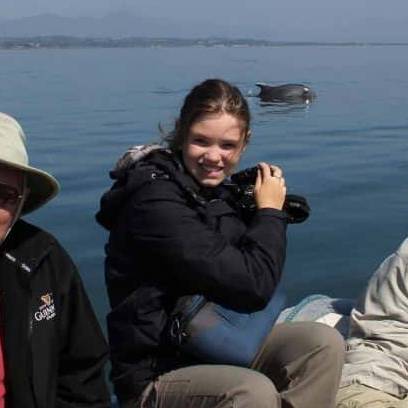
    Every day will be spent at sea as long as the weather conditions allow it.  You will be involved in various research activities, from sighting shifts during the day to night watches, in case weather and sea conditions are good enough to spend the night in the open sea.

    You also help the researchers collecting scientific data, including geographic location of sightings, dive durations, behaviour, group size and composition. In some cases, faecal and prey samples are also collected in order to obtain information on dietary habits of fin whales and sperm whales.

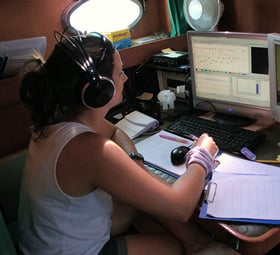
    Researchers and project participants often listen to vocalisations recorded in the field and help in the processing of digital photos of cetaceans sighted, in order to recognise different individuals.

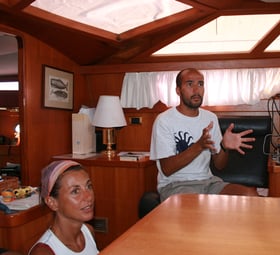
    Lectures on cetacean biology and conservation are also given by the researchers. The skipper is always eager to answer questions about navigation and sailing techniques.

    No previous experience.

    Participants must also be willing to share housekeeping duties and space on the boat. The contributions of the participants over the years represented the main funding source for our research.

    Research is conducted on board our research vessel “Pelagos”, departing weekly from Sanremo(Italy), from May to October.

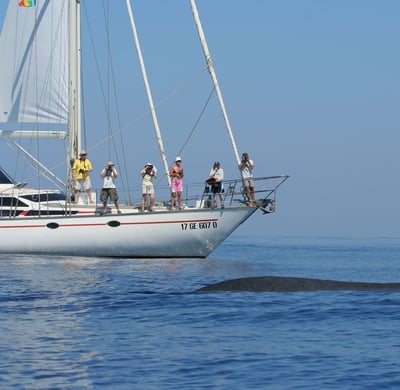
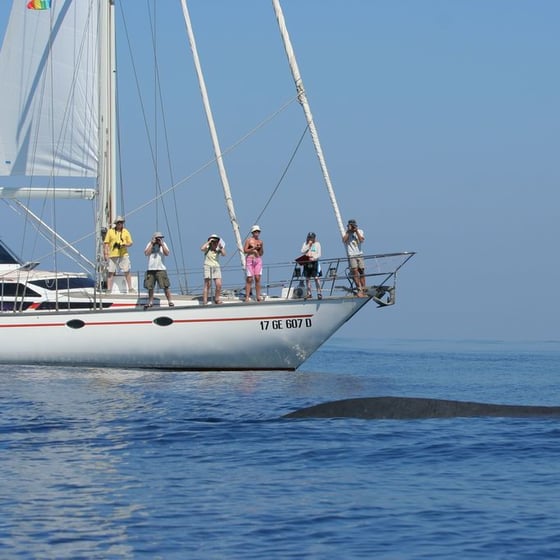
    “Pelagos” is a two-masts motorsailer used for the research with citizen-science participants in the cetacean Sanctuary. The spacious and very comfortable Tethys boat is managed according to the rules of responsible tourism; it is equipped with sophisticated instrumentation used for navigation and the collection of scientific data. “Pelagos” has two masts and can sail and manoeuvre by means of a fully electronic system, that can be switched to manual at any time. An inflatable craft is sometimes used to get closer to the animals. Since 2012 the vessel is cleaned only with eco-friendly detergents (organic,non-toxic and biodegradable), kindly provided by Biolù..


    Tagesablauf

    In a typical day we wake-up between 7:00 and 8:00 AM, depending on circumstances. We will depart after breakfast and spend the day navigating and conducting research. Both researchers and participants will be assigned sighting shifts in order to ensure constant sighting effort.   In some ...

    Tagesablauf

    In a typical day we wake-up between 7:00 and 8:00 AM, depending on circumstances. We will depart after breakfast and spend the day navigating and conducting research. Both researchers and participants will be assigned sighting shifts in order to ensure constant sighting effort.   In some cases, when weather conditions are optimal, a night may be spent at sea for research purposes. However, less favourable conditions will force us to spend the night in the harbour or in a sheltered bay. Once sighted, cetaceans may be followed for up to several hours, while a series of variables and information is recorded. 

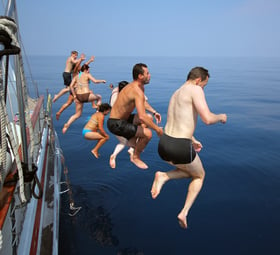
    During the day, there is also time to relax when you are not on shift, and sometimes even stop for a swim break, and learn basic navigation skills from the skipper. 

    One must always bear in mind that flexibility is essential in order to participate to research activities such as this one. Please note that since weather and sea conditions favorable for cetacean sighting and data collection (lack of wind and flat sea) are not the same that allow sailing, the boat normally does not use sails and proceeds with the engine on.


    Freizeitaktivitäten

    In case of unfavourable weather or harsh sea conditions, the boat stays in the harbour or in a sheltered bay. This is not only for the safety of the crew but also because it is not possible to conduct valuable fieldwork in rough seas. Participants may decide to stay on board assisting the ...

    Freizeitaktivitäten

    In case of unfavourable weather or harsh sea conditions, the boat stays in the harbour or in a sheltered bay. This is not only for the safety of the crew but also because it is not possible to conduct valuable fieldwork in rough seas. Participants may decide to stay on board assisting the researchers with data analysis and computer work (e.g. photo-identification of cetaceans) and attending the lectures held by the staff, or they may visit the surrounding area. Along the “Riviera” there are many nice villages for shopping and sightseeing.

    Some places of interest:
    Sanremo (sometimes spelled San Remo) is a city with about 57,000 inhabitants on the Mediterranean coast of western Liguria. San Remo enjoys special weather conditions throughout the year due to its vicinity to the Mediterranean Sea and the presence of the Maritime Alps,
    making it one of the most attractive tourist destinations on the Italian Riviera. There are two tourist harbours: The old Porto Vecchio and the modern Portosole. There are many boutiques and local shops in the town centre. The colourful market, held on Tuesday and Saturday

    mornings in Piazza Eroi Sanremesi, is famous among the people living in the Italian and French Riviera.

    Monte Carlo, 43km from Sanremo is one of Europe's leading tourist resorts. If you plan to visit this city before or after boarding on Pelagos, you should not forget to visit the Monaco Cathedral, the Napoleon Museum, the Prince's Palace and the Oceanographic Museum. The Oceanographic Museum, created in 1910, is a monumental structure with an impressive façade towering above the sea. The museum houses remarkable collections of various marine species and a large section is dedicated to cetaceans.

    Nice is a city in southern France. A major tourist centre and a leading resort city on the French Riviera (Côte d'Azur), it is the historical capital of the County of Nice. It is situated roughly 55km from Sanremo. If you are planning to visit the city, you should not miss the Cours Saleya, with its colourful flower and food market and all its fantastic pedestrian streets for a spot of shopping. The Colline du Château, through the labyrinthine alleyways of Vieux Nice, offers a wonderful view of the city from the top. Nice also has excellent museums like the Matisse museum or the Mamac Museum of modern art.


    Voraussetzungen

    Voraussetzungen

    Mindestalter: 18 Jahre

    Um an diesem Programm teilzunehmen, musst du zu Programmbeginn mindestens 18 Jahre alt sein. Es kann Ausnahmen geben, wenn du die Erlaubnis deines/r Erziehungsberechtigten vorlegen kannst oder wenn du von deinen Eltern begleitet wirst

    Sprachkenntnisse

    Du brauchst folgende Sprachkenntnisse: Englisch (Grundkenntnisse)

    Ausbildung

    No previuos experience is request. In-depth information about the different aspects of cetacean research will be given during the week spent on board through interactive lectures and open discussions. auf From High school to University Niveau

    Benötigte Unterlagen

    You have to declare to be in good health, fit and steady on their legs by signing an application form you ill receive after your reservation

    Staatszugehörigkeit

    Es gibt keine Beschränkungen. Helfende Hände aus aller Welt sind willkommen.

    Andere Fähigkeiten

    Children aged 12 to 15 y old can join us but have to be escorted by an adult. Young people 16-17 y old can come alone but the parent have to fill and sign specific application forms for the parental consent.

    Arbeitszeiten

    Deine Hilfe wird an folgenden Tagen benötigt: Dienstag, Mittwoch, Donnerstag, Freitag und Samstag

    Leistungen

    Leistungen

    Dienstleistungen vor Ort

    Included in the fee:

    • Food and beverages (breakfast, lunch and dinner, except for alcoholic and soft drinks) for the duration of the cruise
    • Accommodation on board
    • Mooring expenses in Sanremo harbour
    • 24h harbour showers
    • Electricity, water heating and cooking costs
    • Fuel for the research vessel and the inflatable craft
    • Lectures and training by Tethys researchers
    • Certificate of involvement in the Cetacean Sanctuary Research
    student discount in May, June and September

    Unterkunft

    Research by Tethys in the Ligurian Sea is conducted from a comfortable vessel, "Pelagos" — a 21m motorsailer with two masts built in 1990. The deck is covered with teak wood and is particularly comfortable. Below deck, accommodation is entirely finished with teak. The comfortable dining room has leather seating, a music player, a computer with a large monitor, a bar and a fridge as well as air conditioning (for use in the harbour or when necessary). The galley is small but comfortable and equipped with three refrigerators. The kitchen is equipped with three fridges and is located in a separate cabin. 

     There are five cabins hosting up to 16 people (up to eleven participants, four researchers and the skipper): 2 four-bed cabins (one for the researchers), and a very large and comfortable cabin for 6 people (2 double and 2 single beds), and a small cabin at the bow with two single beds (for the skipper and one researcher). Each cabin has its own private bathroom, equipped with hot water. In order to preserve the boat’s wood panelling in the bathrooms and control the humidity levels below deck, it is our custom to take hot water showers on deck at the stern while navigating. Otherwise, we benefit from access to the showers in the harbour, 24/7 and free of charge for boat guests. 

    Project participants live and sleep on board Pelagos throughout the duration of the cruise, sharing the same cabins and bathrooms. Internet access is not available onboard, but there are Internet cafés in town.

    Verpflegung

    Before the arrival of the participants we go shopping so you can find on board pasta and rice, spell, couscous, legumes (chickpeas, lentils, peas etc), fresh vegetables such as zucchini, aubergines , tomatoes, potatoes, etc, eggs, cheeses and of course a lot of fruit. Large quantities of water sparkling and fresh water. We have on board also red and white wine and  beer.

    For breakfast you can choose milk (also soya and rice milk), the and coffee, yogurts , biscuits, cornflakes, crisp bread, bread, butter jam and honey, etc, depend on what you prefer.

    Everyday two participants and one researcher will cook breakfast, lunch and dinner and wash up. We will suggest you some recipe always considering the food requirement of  the participants (vegetarians, vegans) and also possibly allergies and intolerances but we encourage participants to prepare different recipes from their home countries and share them with the rest of the team.

    Du musst noch nichts bezahlen

    Was ist NICHT inklusive?

    Was ist NICHT inklusive?

    Abholung vom Flughafen Cote D'Azur Airport

    Das Abholen vom Flughafen ist auch nicht in den Programmgebühren enthalten.

    Internetzugriff

    Vor Ort gibt es leider keine Internetverbindung

    Flugtickets

    Der nächstgelegene Flughafen ist Cote D'Azur Airport (NCE) in Nice. Wir helfen dir günstige Flüge nach Italien zu finden. FINDE GÜNSTIGE FLÜGE

    Reiseversicherung

    Ins Ausland zu gehen ist ein Abenteuer, auf das man sich stets gut vorbereiten sollte. Plötzliche Krankheit oder Verletzung, Stornierung oder Diebstahl - eine Reiseversicherung für Italien bietet die nötige Sicherheit. ANGEBOT EINHOLEN

    Impfungen

    Bevor du deine Freiwilligenarbeit in Italien antrittst, solltest du dich noch einmal von deinem Arzt beraten lassen und deine erforderlichen Impfungen für Italien überprüfen. IMPFSCHUTZ ÜBERPRÜFEN

    Informationen zur Anreise

    Cruises take place between end-May and mid of October each year.

    Boarding on Monday around 6 pm and disembark on Sunday around 11 am.

    ALL 2026 RESEARCH CRUISES ARE FULLY BOOKED! SEE YOU IN 2027. 

    The research season is from May to October during the sunny and warm Mediterranean summer when the whales arrive in the area for feeding.

    Arrival on Monday afternoon around 6 pm and meeting on board the research boat, ice-breaking session, introduction to the project and presentation of all staff and team members, and information about safety measures. 

    Tue-Sat: Visual and acoustic monitoring during navigation surveys in daylight hours; possible nights spent out at sea in favorable weather conditions; daily lectures. 

    Sunday: Pack-up, boat cleaning and departure.


    Verfügbarkeit
    Jan Feb Mär Apr Mai Jun Jul Aug Sep Okt Nov Dez

    Programmgebühren

    $1.293 / Woche 1 - 4 Wochen Alter 18 - 50+

    Zahlungsarten

    Visa Master Card Maestro American Express PayPal

    KEINE KREDITKARTENGEBÜHREN


    Dauer

    1 - 4 Wochen

    Anzahlung

    Reserviere Deinen Platz mit nur wenigen Klicks und einer kleinen, sicheren Anzahlung. Du kannst bequem mit Kreditkarte, PayPal oder anderen Zahlungsmethoden bezahlen.


    Ausstehende Zahlung

    Die Zahlungsweise für die Restzahlung vereinbarst Du während des Bewerbungsprozesses mit Deiner lokalen Organisation. Die Restzahlung wird erst später vor Reisebeginn fällig.

    Du musst noch nichts bezahlen

    4,72
    ・
    10 Bewertungen

    Lage

    Europa > Südeuropa > Italien > Sanremo

    Lerne deinen Koordinator kennen

    Adriana
    10
    Bewertungen
    4,72
    Brilliant
    1991
    Gegründet

    Verifiziert

      Mäßige Antwortrate
    Gesprochene Sprachen: Englisch, Italienisch
    Reise sicher, indem du Volunteer World für deine Kommunikation und Buchung nutzt. So profitierst du von der Flex Option, Refund Guarantee und Resolution Support.

    Das könnte dich auch interessieren

    Kontaktiere Adriana
      Mäßige Antwortrate
    Englisch, Italienisch

    Die meisten Freiwilligen erkundigen sich nach


    Hast du noch weitere Fragen? Schreibe Adriana eine Nachricht
    Bitte teile zur Sicherheit keine pers. Kontaktdaten
    Wähle deine Reisedaten, um einen Preis zu sehen

    Buche mit der Flex-Option!

    Wähle ein neues Abreisedatum oder wechsel zu einem anderen Freiwilligenprogramm ohne zusätzliche Kosten innerhalb von 12 Monaten.

    Umfassende Unterstützung für Freiwillige!

    Damit können wir unsere Plattform betreiben und wichtige Dienstleistungen wie umfassenden Support, Rückerstattungsgarantie, Flex-Option ohne Umbuchungskosten und Preisgarantie anbieten. Darin enthalten ist die Mehrwertsteuer.

    Einzelheiten zum Preis